Architects of the new generation, educated in Vienna, Berlin, Budapest, and Prague, brought with them the language of Secession (Art Nouveau). This style, oriented toward flowing lines, asymmetry, and floral motifs, became a manifesto of the new era. In the Belgrade context, Art Nouveau is closely connected with the Vienna Secession, which had a particularly strong influence on the city and introduced a more rational and geometric interpretation of modernism. Nikola Nestorović, Andra Stevanović, and Branko Tanazević played a crucial role in shaping the architectural character of this period. Their projects combined the decorative language of modernism with an academic foundation and the local context, creating the architectural hybridity characteristic of Belgrade. In the city, Secession rarely appeared in its radical, “pure” form. More often it functioned as a flexible decorative layer applied to familiar academic structures, gradually accustoming citizens to a new aesthetic through the elegance of mascarons, cartouches, and wrought iron.
Alongside Art Nouveau and Secession, the Serbian-Byzantine style was also developing in the city, responding to the same challenges of the time in a different way. If modernism expressed the aspiration toward European modernity, the Serbian-Byzantine direction was connected with the search for a national architectural identity and the reinterpretation of medieval heritage in the forms of urban architecture. These directions did not exist in isolation and often coexisted within the same era, and even within the works of the same architects. Secession served here as a unique link: it allowed the cosmopolitan ambitions of academicism to be reconciled with the search for the distinctive aesthetics of a sovereign nation.
- Art Nouveau refers to the pan-European artistic movement oriented toward the renewal of forms, ornament, and the expressive use of line.
- Secession denotes its Central European version, primarily the Viennese one, which is more restrained and rational.
- Modern is used as a broader concept encompassing the entire spectrum of new architectural explorations at the turn of the century, including Art Nouveau, Secession, and transitional forms leading toward interwar modernism.
The route in this guide is not meant to be strict. The locations are scattered across the city center and are not intended to be followed in a fixed sequence. Rather, it is a collection of points for leisurely exploration. You can choose buildings along your way, combine the walk with a coffee stop or a visit to a courtyard, and observe the architecture of the early twentieth century at a pace that suits you.
Karađorđeva 48
The Belgrade Cooperative for Mutual Aid and Savings was founded in 1882 by a group of local merchants with the aim of supporting the middle class through favorable loans and financing entrepreneurial activities. Immediately after the completion of the building in 1907, the Cooperative moved into its new headquarters. Shops occupied the ground floor, while the upper floors housed administrative and management offices, including banking and insurance departments. Later, the building was used by the Geological-Geophysical Institute “Jovan Žujović,” which is why many locals still refer to it as “Geozavod.”
The architectural concept of the building combines an academic foundation in the spirit of Neo-Baroque with elements of Art Nouveau. Its monumentality, complex composition and rich plasticity of the facades reflect the social importance of the Cooperative. The interiors represent a striking example of the synthesis of the arts: wall and ceiling paintings, sculptures, stucco decoration, stained glass, wrought-iron elements, chandeliers, and decorative glass partitions of the banking hall form a unified artistic whole. It is precisely for this reason that the building was declared a cultural monument of exceptional importance.
After a major reconstruction in 2014, the building became the headquarters of the Belgrade Waterfront project and also houses one of the city’s most famous restaurants, “Salon 1905.”
Karađorđeva 50
The building was designed as an architectural “counterpart” to the Belgrade Cooperative, forming a ceremonial entrance to the city’s elite financial district for those arriving from the river port and the railway station. The uniqueness of the hotel lies in its five-facade composition: four façades face the surrounding streets, while the fifth, cut at an angle, is oriented directly toward the Cooperative building.
While the composition rests on an academic foundation, the faсades are executed in the spirit of French Secession. Flowing, wave-like surfaces, vertical rhythms of windows, and rich Secessionist decoration with friezes, mascarons, and floral garlands give the building lightness and dynamism. The corners are accentuated by hexagonal bay windows topped with domes, reinforcing the building’s vertical silhouette.
The hotel also represented an engineering breakthrough. Because of the marshy soil, the foundation rests on 900 concrete piles, and a system of reinforced-concrete beams was widely used in the floor structures, making the building a model of advanced construction thinking of its time.
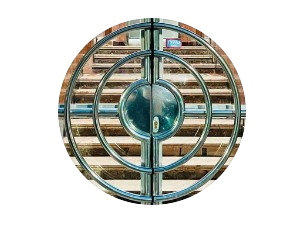
The main entrance is located on Karađorđeva Street and leads into a restrained vestibule, behind which a carefully designed interior unfolds. At the center of the block lies an inner courtyard-atrium that provided natural light and ventilation even for rooms not facing the street. The restored entrance doors of the hotel today clearly demonstrate the high level of craftsmanship characteristic of the early twentieth century.
Karađorđeva 61
The project was designed by architect Dimitrije T. Leko, who proposed a restrained, “national” interpretation of Secession, close to eclecticism. In contrast to the richly decorated Cooperative building, the Vučo house is conceived in a more laconic manner, with emphasis on proportions and silhouette. The expressive corner solution, with its widely opened facade, visually expands the intersection and transforms it into a full-fledged urban space. The rhythm of the window openings and the clarity of the facade surfaces emphasize the monumentality of the building and anticipate the transition toward the stricter language of interwar modernism.
The appearance of the Vučo house marked an important stage in the transformation of Savamala from a peripheral riverside district into an elite commercial and financial center. The building combined commercial premises on the ground floor with residential apartments above, reflecting the typical model of prosperous Belgrade at the beginning of the twentieth century. The restrained yet expressive portal and the details of the window frames function as visual markers of status and of the aspiration toward architectural modernization.
Kosančićev venac 22
The house of Mika Alas is a model example of how Belgrade architects at the beginning of the twentieth century used Art Nouveau to create a new national style. Bajalović moved away from blindly copying historical models and proposed a lively, asymmetrical facade composition. One of the most recognizable elements of the building is a window frame shaped like the Greek letter omega. Inside it is a two-colored checkerboard pattern, a direct reference to the decorative motifs of the Morava school of medieval Serbian architecture. The facade is decorated with refined reliefs depicting water lilies and reeds, emphasizing the owner’s deep connection to the world of water and nature. The ceremonial wooden entrance doors are decorated with carved figures of fish, created at the personal request of the scientist. This transforms the door from a functional element into a visual symbol of the homeowner’s identity. The entrance corridor and vestibule were also filled with personal meanings: on the stair landings there were once niches with figures of Napoleon and Pascal, whom Mika Alas, as a “student of the French tradition,” deeply admired.
The house was damaged in both world wars and for a long time stood with much of its decoration lost. In 1968, on the centenary of the scientist’s birth, the first major restoration was carried out based on archival drawings and photographs from 1921. In 2017–2018, as part of the broader reconstruction of Kosančićev venac, the facade regained its original brilliance, including the restoration of mascarons and the complex sculptural plasticity in the balcony area from which the scientist once admired the view of the confluence of the Sava and the Danube.
Gračanička 18
The Pavlović house represents a masterful combination of an academic structural composition and Secessionist decoration. The main visual accent of the building is the rounded corner crowned with a Baroque dome. This corner is further emphasized by an elegant oval balcony with a wrought-iron railing on the level of the first floor.
On the facade Nestorović used his characteristic repertoire of motifs: female mascarons at the tops of the pilasters, dense floral garlands, volutes, and a central cartouche on the attic bearing the owner’s monogram “MP.” The verticality of the building is emphasized by pilasters separating the windows, while in the attic level above the cornice Nestorović placed semicircular tripartite Palladian windows, giving the building a resemblance to European palaces of that era.
Behind the entrance door lies a spacious representative vestibule. All living spaces are organized around a central hall illuminated by natural light through a fixed glass lantern in the roof. The layout clearly separated public zones — salons and a dining room with a semicircular niche on the main level—from the private family quarters located on the upper floor.
Interestingly, before moving into this house the Pavlović family lived in a building on Studentski trg, which they later sold to a bank. Today the building at Gračanička 18 is also known as the location of the Institute of Criminological and Sociological Research, which has helped preserve its interiors and facade sculpture in good condition.
Gračanička 16
The client was Dimitrije Živadinović, an influential figure in the business circles of early twentieth-century Belgrade: a banker, merchant, and president of the board of the famous Belgrade Cooperative. Originally the building had a mixed commercial and residential function. The basement and ground floor were intended for business operations, including securities trading, while the second floor contained residential apartments. In 1926–1927 the building “grew” by two additional floors. This delicate extension was designed by architect Samuel Sumbul, who managed to increase the scale of the structure without disrupting its original stylistic character.
The main treasure of the house lies behind its entrance. The vestibule and corridor represent a unique example of the synthesis of the arts at the beginning of the twentieth century. The walls were painted by the renowned decorative artist Dragutin Inkiostri (Medenjak), often considered the first interior designer in Serbia. In his design Inkiostri skillfully combined allegorical figures, Art Nouveau ornaments, and scenes of Venice and Dubrovnik, which were rare in residential interiors of that time. His work in this building is often compared with the murals in the house of Jovan Cvijić and in the Vuk Foundation.
The building is also notable for its use of reinforced concrete in floor structures, balconies, and bay windows, which was an innovation for that period. Today the house of Dimitrije Živadinović is recognized as a cultural monument that embodies the era when the Belgrade elite actively began introducing European taste and modern construction technologies into the appearance of the capital.
Cara Lazara 16
In the history of Belgrade construction, the building is notable primarily for its technological innovations. Although Tanazević is often associated with the decorative character of the “national style,” in this project he revealed himself as a bold engineering experimenter. In constructing the floor structures, the architect used the progressive reinforced-concrete beam system known as “Herbst.” The most complex and interesting element was the radial application of the Herbst system in the construction of the side bay windows. This solution made it possible to create strong yet lightweight projecting structures that became a distinctive feature of the facade.
The house of Rista Jovanović serves as an example of how, at the turn of the century, Belgrade architecture brought together high artistic expression and modern engineering. The use of reinforced concrete allowed Tanazević to realize complex spatial forms, such as the bay windows, without sacrificing the decorative expressiveness characteristic of his architectural language.
Kralja Petra 16
The client, Bencion Buli, belonged to a well-known Sephardic family and was an important figure in the business world of Belgrade. His department store on Kralja Petra Street became a visual symbol of the city’s European ambitions, combining technological progress with aesthetic refinement. The project was designed by architect Viktor Azriel, for whom this building became almost the only realized project in Belgrade. Azriel’s main innovation was the use of an iron frame, which made it possible to create large glazed surfaces on the facade — the first composition of this kind in the city. Unlike the massive stone walls of academic architecture, the facade appears as a light, transparent membrane. Its vertical divisions are emphasized by marble-clad lesenes carved with delicate Secessionist motifs.
Despite the industrial logic of the structure, the building is richly decorated with motifs typical of Art Nouveau. The facade is crowned with characteristic female faces with flowing lines of hair. The balconies are adorned with intricate wrought-iron patterns combining floral and geometric forms. One particularly important detail, unfortunately not restored during recent renovations, was the door handles shaped like swans.
The novelty of the building lay not only in its outward appearance but also in its interior organization. Inside, a spacious atrium was created that allowed visitors to see all the floors of the department store at once, producing a sense of openness and transparency previously unknown in Belgrade’s retail spaces.
Kralja Petra 39
The house of Aron Levi stands in close proximity to the famous “House with Green Tiles” (Kralja Petra 41), making it possible to clearly observe two different approaches to modernism within the same street. Unlike its more radical neighbor at number 41, Levi’s house is designed in a more classical manner. The architect preserved the traditional division of the facade, without striving for a strong dominance of vertical lines over horizontal ones.
The decoration of the building fully belongs to the aesthetics of Secession. It includes female mascarons, floral motifs, as well as garlands and wreaths that elegantly frame the window openings. The facade is enriched with sculptural decoration that gives the building a sense of status and emphasizes the refined taste of its owner.
As in other representative buildings of this period, the entrance zone and portal of Aron Levi’s house are key elements of the building’s visual narrative. The entrance is decorated with carved wooden doors whose ornament repeats the flowing lines and plant forms characteristic of Art Nouveau.
The fact that Aron Levi commissioned the building reflects a broader tendency of the time: the merchant class was the main driving force behind the modernization of Belgrade architecture. Choosing Secession instead of the conventional academic style allowed owners to express their belonging to modern European culture and to emphasize their individuality through the unique decoration of the portal and facade.
Kralja Petra 41
The main feature of the building is its polychrome facade clad in glossy green ceramic tiles, which was an absolute novelty in Belgrade at the beginning of the twentieth century. Instead of traditional horizontal division, a strong vertical rhythm dominates: pilasters run across the entire facade, breaking the classical cornice and ending at the attic level with decorative pedestals topped by urns.
The decoration combines female mascarons, geometric ornaments, and stylized floral motifs. The ground floor is designed with a smooth surface without rustication and visually merges with the upper floors, giving the building a sense of unity and lightness.
The Stamenković house is a striking example of the principle of total design. The architects designed not only the facade but also the details — wrought-iron balcony railings, chimneys, and entrance doors. The main portal on Kralja Petra Street is framed by carved wooden doors with a characteristic Secessionist glazing pattern that recalls the Viennese school of the early twentieth century.
According to a family legend, the client wanted the house to resemble buildings she had seen near Lake Balaton. The close relationship between the owner and Nikola Nestorović gave the architects a degree of freedom that was rare at the time, allowing them to realize one of the boldest and most individual projects of Belgrade Art Nouveau. Today the building remains an important visual landmark on Kralja Petra Street and one of the most expressive symbols of Belgrade’s modernization at the beginning of the twentieth century.
Francuska 31
The house of Leona Panayot represents an example of how, at the beginning of the twentieth century, Belgrade architecture began to move decisively away from the strict symmetrical schemes of academicism. Instead of rigid division of the facade, the architect proposed a freer and more dynamic composition in which decorative elements are not merely applied to the walls but create a distinctive “rhythm” of the building.
The facade is decorated with motifs typical of Secession—plant, anthropomorphic, and geometric ornaments that replace the classical academic decoration. The entrance zone serves as the “heart” of the entire decorative system of the facade. Bajalović deliberately shifted the visual focus to the portal, making it the most elaborate element. The decoration surrounding the doorway flows smoothly into the design of the window openings, creating a unified artistic composition. The fluid, flowing lines of the ornament around the entrance reflect the cosmopolitan spirit of Belgrade in that era.
Bulevar despota Stefana 45
The owner of the building and well-known Belgrade contractor Knoll was a notable figure in the city’s construction world at the time. He personally supervised the works not only on his own house but also on many other significant Secession-style buildings, such as the building of the Prometna Banka on Knez Mihailova Street.
The building was designed as an income-producing apartment house. It contained four spacious apartments: two facing the street and two oriented toward the inner courtyard. The house is notable for the way it intertwines old and new architectural principles. At its core lies a classical academic structure — an asymmetrical composition with an emphasized side risalit and traditionally profiled cornices. Upon this strict base is placed a rich decorative repertoire of Art Nouveau. Just below the roof the facade is decorated with female mascarons as well as abundant floral and anthropomorphic ornamentation. The windows of the second floor have the form of segmental arches and are crowned with richly decorated pediments, giving the building the fluid character typical of Secession.
Sources highlight an interesting detail: two versions of the facade design from 1911 and 1913 have survived. In the first version from 1911 the architect proposed a more traditional and historical solution. However, by 1913, in the realized project, Simić completely reworked the decorative scheme, incorporating bold Secessionist elements into the academic composition and making the house thoroughly modern for its time.
Đure Daničića 10
The house entered architectural history as one of the first examples of reinforced concrete being used in private construction in Belgrade. In 1910 such engineering solutions were rare and were usually associated with large public projects. For Putnik, his own house became an experimental platform where structural innovation was combined with an expressive facade.
The history of the building consists of several layers. Originally it was a single-story mansion in the Art Nouveau style. In 1926 the house was expanded with two additional floors and a mansard. During this enlargement it was possible to preserve the stylistic unity and the key features of the original project. For a long time it was believed that the Secessionist decoration had been lost, but the restoration carried out in 2018 revealed and restored the original ornaments from 1910, which had been hidden beneath later layers of plaster.
Particular attention is drawn to the entrance portal. Here the door functions not only as a practical element but also as a visual marker of the owner’s identity. The strict engineering logic of the structure is combined with wrought metal and decorative stucco, creating the characteristic dialogue between technology and ornament typical of Belgrade modernism.
Jelene Ćetković 5
The house of Cvijić is one of the most vivid examples of how European modernism entered the private life of the Belgrade intelligentsia. It is believed that the choice of style was influenced by Cvijić’s participation in the World Exhibition in Paris in 1900, where the general atmosphere and the newest artistic movements inspired the scholar to build his own home in the spirit of Secession.
The main value of the house lies in its interior decoration, which was entirely designed by the decorative artist Dragutin Inkiostri (Medenjak). Corridors and rooms are adorned with wall paintings that combine Art Nouveau ornament with allegorical figures and landscapes. Inkiostri sought to create a modern Serbian style, so the interiors are strongly influenced by elements of folk art. A striking example of this approach is the unique ceramic stove in the central room, specially designed by the artist in the spirit of traditional craftsmanship. The ceilings are decorated with plaster rosettes and borders, while the floors are finished with high-quality oak parquet.
Nušićeva 27
The project was prepared by the owner himself, engineer Jovan Smederevac, who had been educated at the Technical University of Vienna. Smederevac was a prominent figure in engineering circles, participating in the construction of railways and bridges and working in committees responsible for the modernization of the city. Although some researchers doubt that the engineer personally designed the artistic decoration of the facade, his role as an initiator of the introduction of the “new art” is unquestionable.
In its structure, the Smederevac house remains faithful to academicism: it has a strict symmetrical composition, a clearly articulated facade, and classical proportions. However, the decorative layer fully belongs to the aesthetics of Art Nouveau. The facade is decorated with distinctly realistic floral motifs. Among the lush vegetation one can find representations of thistles and vases with flowers. On closer inspection, butterflies can be discovered among the stone flowers, and on the sides of the central balcony there are two ornaments shaped like peacock feathers. The corner of the building is cut and emphasized with an elegant wrought-iron balcony. This part of the building is crowned with a dome in the form of a truncated pyramid with oculi (round windows), which unfortunately are now closed.
The entrance is positioned along the central axis of the cut corner. In the design of the entrance and window openings, elements of wrought iron and mascarons in the form of female heads are used, which for 1901 represented a radical departure from familiar classical conventions.
The house of Jovan Smederevac was declared a cultural monument in 1966. It remains an important testimony to how the Belgrade elite at the beginning of the twentieth century sought to keep pace with European trends, using decoration as a way to express cosmopolitan identity and participation in contemporary artistic movements.
Svetogorska 27
The building was constructed for the merchant and professor of the Commercial Academy, Josif Predić, on a plot owned by his wife Marija. The house has particular historical and memorial value because the owner’s brother, the famous Serbian painter Uroš Predić, lived and worked here. The large window of his studio faced the inner courtyard, where the artist continued to work until the end of his life.
Nestorović applied a decorative approach that was new for its time. The walls are adorned with wide decorative bands with plant motifs, among which a relief of a vine with grape clusters above the first-floor windows stands out. The decoration includes the architect’s favored motifs — female mascarons, garlands, and bouquets of flowers. The facade is distinguished by an expressive color scheme combining terracotta, yellow, and light tones, emphasizing the Secessionist character of the building. The upper part of the structure is crowned with a decorative attic element with a central oculus framed by floral arabesques.
The main entrance door is placed asymmetrically, reflecting the shift away from the strict canons of academicism toward the freedom of modernism. The entrance is decorated with wrought elements with flowing plant patterns, and a colored stained-glass panel has been preserved above the door.
Behind the entrance lies an elegant spiral staircase with an elliptical base, whose railing is also executed in the Art Nouveau style. An unusual detail is the sculpture of a dog placed beneath the staircase. Interestingly, a similar element appears on the staircase in the house of Leona Panayot, highlighting the shared artistic vocabulary of that period.
Stevana Sremca 5
In the design of the house Tanazević skillfully combined international Art Nouveau motifs with local traditions. The facade is decorated with characteristic mascarons and rich vegetal sculptural ornament. Elements inspired by folk art are also present in the decoration, making the building a vivid example of the national style.
Particular attention should be given to the wrought-iron gate, decorated with a distinctive sunflower motif characteristic of this house. On the facade one can also see the owner’s initials and the year the building was constructed.
For many years this address attracted visitors thanks to the popular café “Ljutić,” which operated inside the villa and allowed guests to see partially preserved interiors and experience the atmosphere of an elite residential space from the early twentieth century. Unfortunately, the café closed several years ago, and today the villa has once again become a closed private residence.
Kosovska 47
The facade of the building is exceptionally picturesque and is often compared to a “stone carpet.” Tanazević rejected the familiar heaviness of academic architecture, transforming the walls into something resembling a large woven kilim. The geometric ornament with red accents, rosettes, and checkerboard motifs refers to medieval heritage, while the vertical rhythm of the windows, which become smaller toward the top, follows the principles of international Art Nouveau. In the lower part of the facade, decorative jointing inspired by Byzantine masonry techniques is used.
The corner solution of the building plays a particularly important role. It is crowned by a light lattice dome with a star-shaped, almost lace-like structure that gives the building a strikingly expressionist character. Interestingly, the building was originally planned to stand exactly on the corner line, but at the request of the ministry it had to be set back into the plot, which required the project to be widened by one meter.
The central entrance on Kosovska Street is integrated into the overall decorative rhythm of the facade and reflects the principle of total design characteristic of Tanazević. In 1925 the building was expanded with an additional floor according to the architect’s own project, while its stylistic unity was fully preserved.
Today the Old Telephone Exchange is considered a cultural monument of exceptional importance and one of the most vivid examples of the search for a modern Serbian architectural language at the beginning of the twentieth century.
Terazije 39
The building stands on an exceptionally narrow and deep plot, which is characteristic of development in the very center of the city. Its complex layout includes several wings and side light wells that provide natural illumination for the interior spaces. The palace was conceived as a multifunctional commercial and residential building: the ground floor and mezzanine were intended for business use, above them were two floors with luxurious apartments, and a mansard level.
On the central axis of the facade stands a distinctive polygonal bay window. Researchers note the unusual character of its compositional placement, as it is not entirely geometrically aligned with the cubic bay window located on the floor below. Inside the building, notable details of early twentieth-century total design have been preserved, including an old elevator with a wrought-iron enclosure and decorative floor tiles with floral ornament.
This building is an important testimony to how, in the early twentieth century, major financial institutions and wealthy merchants transformed the appearance of Terazije Square by introducing modern European standards of housing and commercial space.
In 1965 the building was declared a cultural monument, and according to later decisions it has been recognized as an immovable cultural property of great importance for the Republic of Serbia.
Terazije 40
The upper floor housed a bright photographic studio with a glass roof — a space literally created for working with light. As early as 1911, the Colosseum cinema opened in the courtyard, becoming a natural continuation of the building’s story as a place dedicated to visual culture. After the Second World War the cinema was renamed “Zvezda,” the name by which generations of Belgraders remember it.
In the 2000s the building was closed and gradually fell into neglect. In 2014 it was occupied by activists who transformed it into the independent cinema Novi bioskop Zvezda. The traces of time and the weathered interiors were not concealed. On the contrary, they became part of the atmosphere. Watching a film here turns into an experience of immersion in the multilayered past of the city.
The facade still preserves the characteristic features of Secession — flowing lines, decorative plasticity, and the unity of the artistic concept. Terazije 40 is not merely an architectural monument, but a place where modernism, cinema, and urban memory continue to exist simultaneously.
Kralja Milana 2
The building was originally constructed in 1870–1871 according to the design of architect Aleksandar Bugarski as a private residence. Its present appearance is the result of a major reconstruction of the facade carried out between 1907 and 1912 by architect Branko Tanazević for the needs of the Serbian Ministry of Education. Later, in 1924, the courtyard wing was expanded according to the project of Žarko Tatić. Since 1988 the building has been managed by the Vuk Karadžić Foundation.
Instead of the international language of Art Nouveau, Tanazević deliberately chose the Serbian-Byzantine style, adapting it to a modern urban and administrative function. The facade is designed in the spirit of the Morava school of medieval Serbian architecture: stone “interlacing,” rhythmic polychromy of light surfaces and dark red relief elements, checkerboard motifs, rosettes, mascarons, and ornamental “embroidery” around the windows create a rich and easily recognizable national code. In this context the Serbian-Byzantine style appears as an alternative response to the challenges of modernization, developing in parallel with Art Nouveau and Secession. While modernism expressed Belgrade’s aspiration toward European modernity, buildings such as Vuk’s Endowment searched for a form of national identity within the same historical moment.
From an urban perspective, the building occupies an exceptionally important position at the junction of Kralja Milana Street and Terazije, entering into a visual dialogue with the New Palace and other representative buildings of the city center. It marks a moment when Belgrade was speaking several architectural languages at once, and it is precisely this architectural multilingualism that makes the urban fabric of the early twentieth century particularly expressive.
Njegoševa 11
The facade demonstrates a mature interpretation of Secession applied to a traditional residential structure. It is divided into five vertical fields in which floral and linear decoration spreads across the entire surface, emphasizing a vertical rhythm and moving away from the horizontal emphasis typical of academic architecture. The restrained decorative character is combined with flowing lines and motifs that anticipate the formation of a national architectural language.
The layout reflects the standards of representative housing of that time. The enclosed staircase is placed along the central transverse axis and positioned toward the courtyard side. Each floor contained two apartments: one larger unit with three rooms facing the street and a smaller one with two rooms also facing the street. In buildings of this type it was common to design two entrances — a ceremonial entrance for residents and guests and a secondary entrance for servants — ensuring a clear separation between representative areas such as salons and the more private service spaces.
The entrance portal plays an important role in the composition of the house. It serves as a visual transition from the facade to the interior and reflects Tanazević’s aspiration toward the principle of total design, in which the door, the staircase space, and the rhythm of the facade form a unified architectural whole.
Prote Mateje 52
The house is a vivid example of how, in the early twentieth century, Serbian architecture combined traditional forms with new decorative currents arriving from Vienna, Munich, and Paris. The project was designed in the spirit of academicism, with pronounced Neo-Baroque elements and touches of Art Nouveau plasticity.
The main facade is clearly divided into two zones — the base and the upper section — by a massive cordon cornice. The walls are decorated with rich floral motifs that soften the strict academic lines and give the facade a picturesque quality.
The entrance doors possess particular stylistic and craft value. The portal of house No. 52 is often cited in studies as an example of “baroque-influenced Secession,” where the dynamic volumes of the pediment are combined with the refined detailing characteristic of Belgrade Art Nouveau.
Although the building is not always officially listed among the most prominent architectural monuments, researchers emphasize its importance as a “pearl” of prewar eclecticism that preserves the authentic spirit of Belgrade’s decorative age.

doors of Belgrade
Any copying and reproduction of text, photos and/or graphic materials, including partial and in any forms,
without the written permission of the copyright holder is prohibited.
